A weekend in the Dales
The Club’s annual trip to the Yorkshire Dales is a highlight for many club members and rightly so. It’s a wonderful place to ride a bike with fabulous scenery
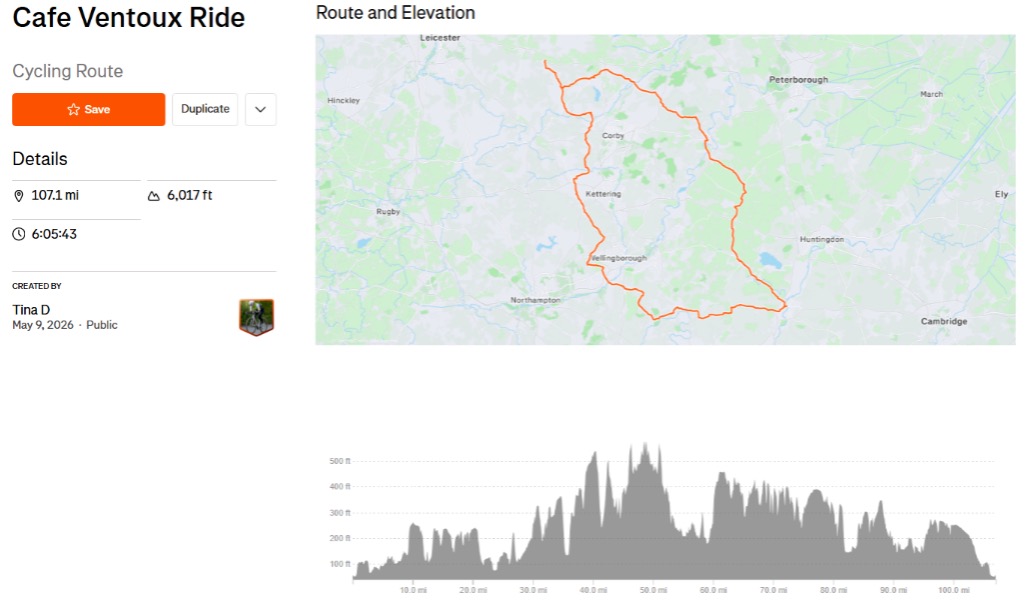
The club typically holds a 100-mile ride in the summer, with Finchingfield and Café Ventoux being favoured destinations. This year, with the Dales trip and the Dragon ride fast approaching, there were several requests for a long ride with plenty of ascent, and so Café Ventoux got the nod. Taking its name from the famed Mont Ventoux, a rename to Vesuvius might have been more appropriate; it was HOT, HOT, HOT.
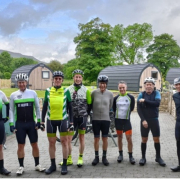
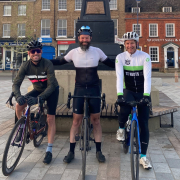
Despite the extreme weather, 13 hardy souls pitched up at the Market Square with sunscreen applied, extra-large bidons filled to the brim, and pockets stuffed full of sustenance. For some, it was an opportunity to chalk up some hill training ahead of the Dales and Dragon rides; for others, a chance to notch up their first 100-miler; for Justin, fresh (?) from his 400km epic over the previous two days, an opportunity to confirm his body was still functional.
From the outset, the emphasis was on riding to the capabilities of the group and respecting the weather. It was great to see the encouragement and support given to the less experienced members, and this was fundamental in making it a truly memorable ride.
The committee had planned several checkpoints for refuelling and re-hydrating, with the New Lodge café in Bulwick being the first stop just over 30 miles in. At this point, four of the contingent, Ebony, Ash, Mark and Tom, decided that was far enough and headed back the way they had come. Full credit to Ebony and Ash for chalking up their longest rides to date — 70-plus miles in that heat is no mean feat — and to Mark and Tom for making sure they got back safely.
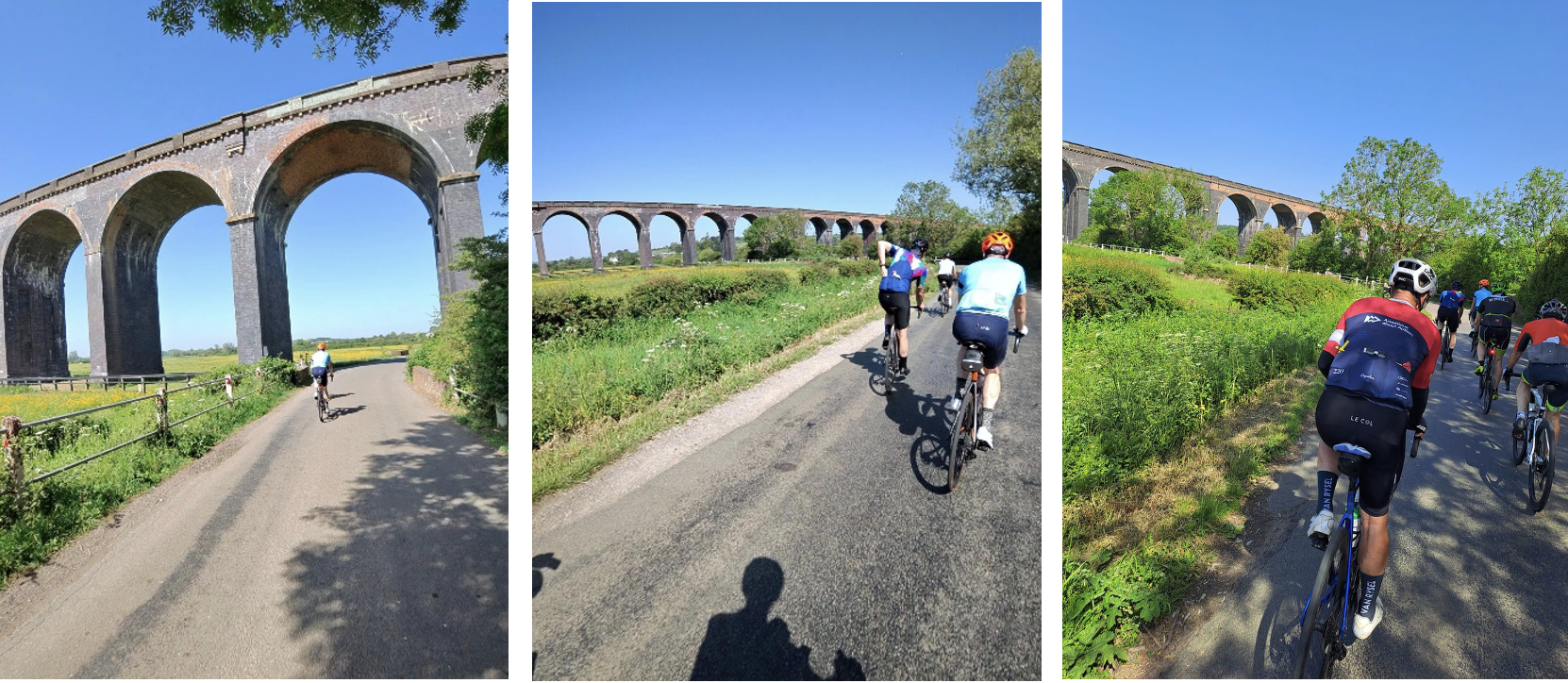
The remaining nine headed onwards to the next checkpoint, the impressive Welland Viaduct near Harringworth at 35 miles, which marks a distinct change in the elevation profile. Those who had requested extra climbing started to rue their words, but the prospect of the café stop spurred everyone on.

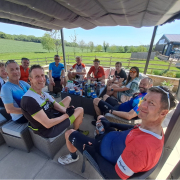
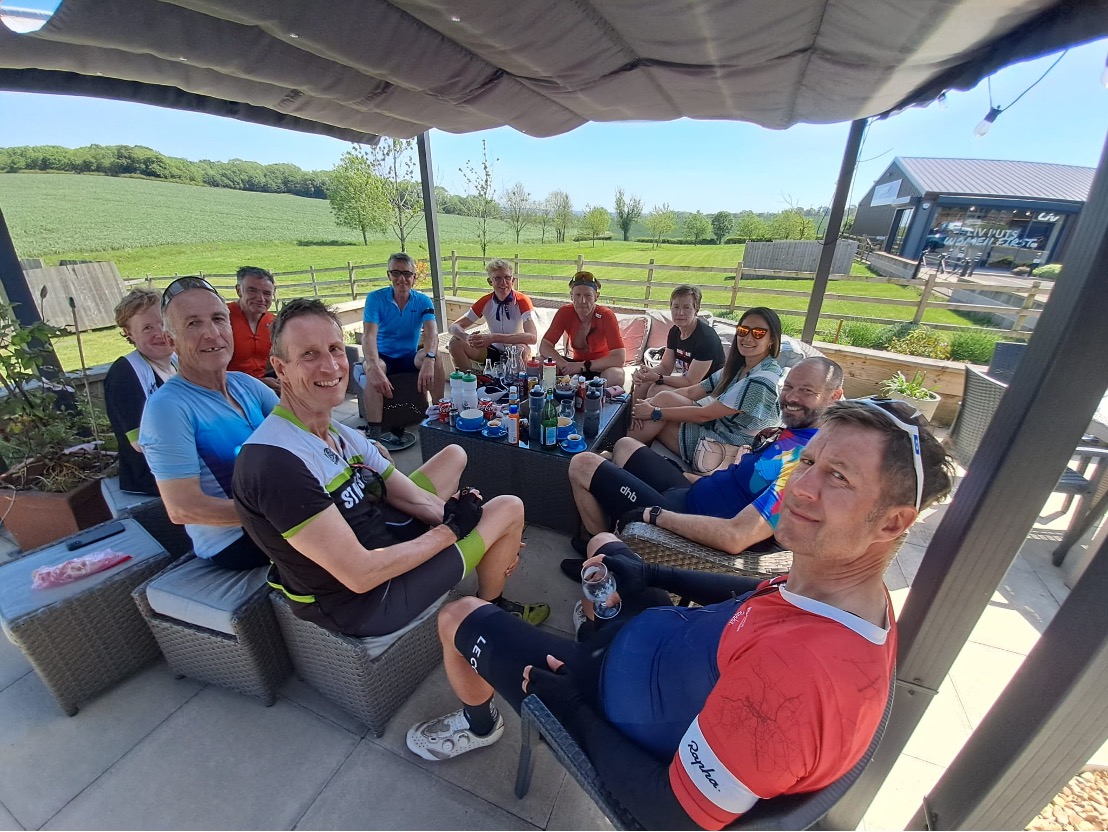
Lesley and Veri had driven up to meet us at Café Ventoux, with the express purpose of confirming that the menu contained suitable high-calorie treats to replenish dwindling reserves. The café did not disappoint.

When we eventually prised ourselves out of the comfy seats, Paul was “extremely disappointed” to discover a puncture and, “rather than hold up the group”, opted to accept a lift back with Lesley and Veri, leaving eight to embark on the return leg. Mercifully, the next ten miles were predominantly downhill, giving lunch a chance to settle and tired legs a chance to wake up. By 60 miles, now in the full heat of the day (32°C), the profile ramped up again with a series of double-digit climbs to seriously test the riders’ resolve.
The last 30 miles seemed to take an eternity with energy and water supplies running low. Fortunately, Justin had factored in a strategic stop at the Co-op (where Tom Muldoon had needed resuscitation the previous year) to replenish supplies. Tina and Stuart were so hot that they re-enacted the iconic Flashdance water-dowsing scene — a moment that deserved to be photographed…
Despite everyone running low on energy, reaching the start of Bushmead Road triggered a wave of relief that home was only five miles away. The remaining seven (Steve having peeled off for Perry) finished the ride in perfect formation. It did cross my mind that this would be the perfect moment to steal Justin’s crown in the town sign sprint — surely he must be just a little tired after 400km and 5,000m of ascent over the previous two days — but that would have been at odds with the group’s “one for all, all for one” ethos. And he probably would have beaten me anyway.
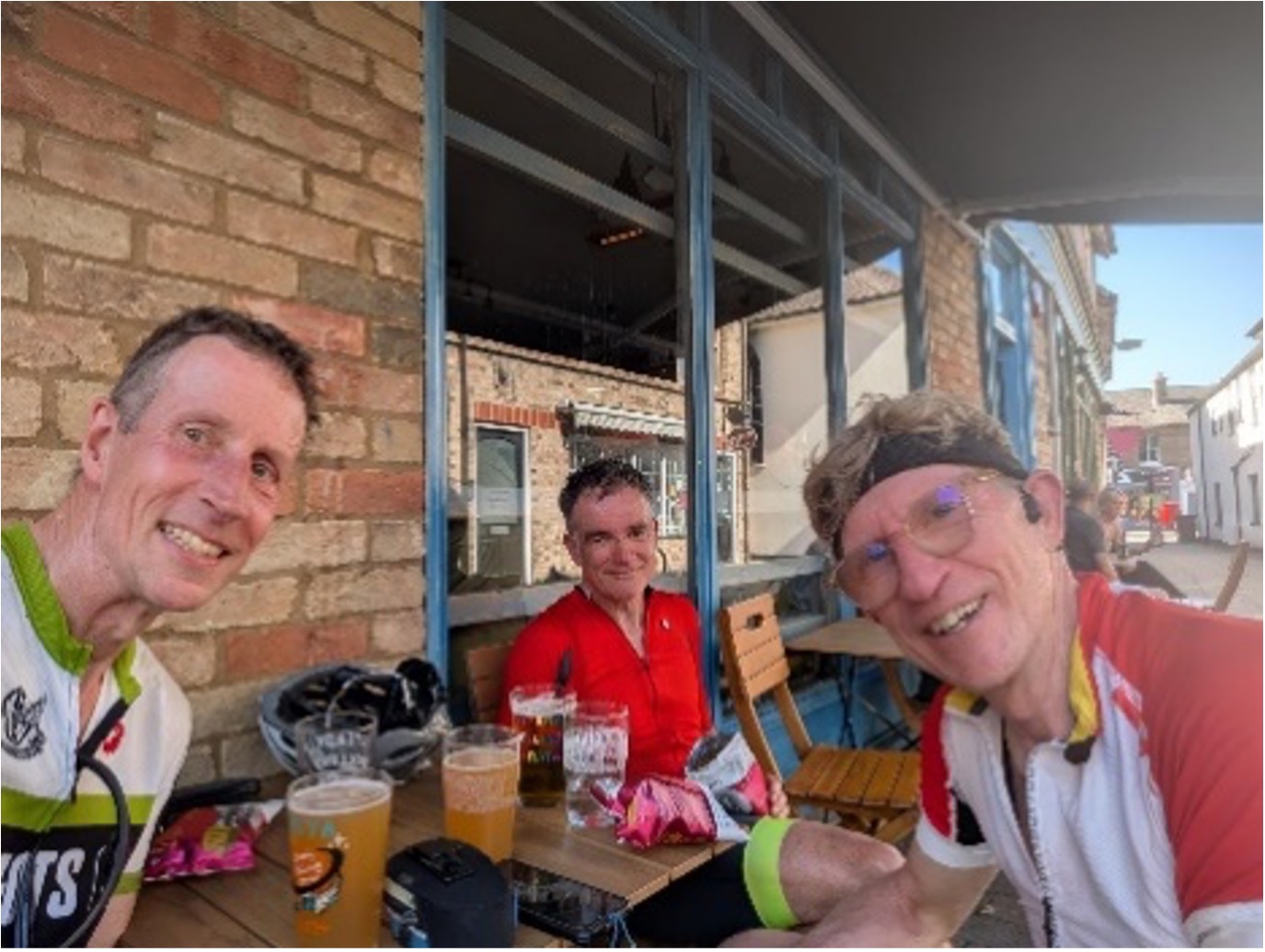
Those without a pressing need to get home, collect the children, walk the dog or see to the other half completed the ride in customary fashion, with a beer at Shume.
Thank you all for a truly memorable ride — especially to the organisers. A triumph of sound preparation, sensible pacing and teamwork over climate change.
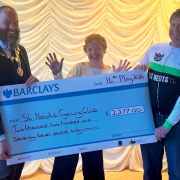
At my Annual Town Council meeting held last week, it was a privilege to hand over a donation to the club’s chair and secretary. I’ve been raising money for three brilliant clubs this year. I’ve seen firsthand how New Saints Boxing Club, St Neots Cycling Club and St Neots Hockey Club support their communities and members. I’m so pleased that £6,831 raised through the golf day, dragon boat festival and other events will go directly to supporting the people who make these clubs tick. Thank you to everyone who took part, donated, or cheered us on. It genuinely means a lot.
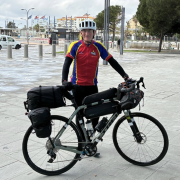
I wanted a solid endurance block, something that would build real durability rather than just fitness on paper. Riding from Gibraltar to the UK gave me exactly that—around 135 hours in the saddle over 19 days.
The night before I left, I found myself at Beer at the Hut, opening a beer festival in aid of the 1st St Neots Scout Group. Not a bad way to spend one of my last evenings as Mayor. If you’d told me then what the next three days would feel like, I’m not sure I’d have believed you.
I was feeling genuinely nervous. A 300-mile ride across England and into France, culminating in a visit to our twinned town of Fâches-Thumesnil, was always going to be a challenge — but it was one I’d been determined to do. The twinning has been part of St Neots life since 1990, and I wanted to mark it with something more than a handshake and a flight.
A huge thank you to Justin Lomas, chair of St Neots Cycling Club, Tom Stead for being my coach, mentor and planner and David Harris of BikeNV — the only cycle repair shop left in St Neots — who serviced my bike before the trip. It made a difference.
After six months of planning with Tom for this trip it was unfortunate that he could not make the trip with me after an injury. It is such a shame but I have suggested we go back next year.
I set off at 6am. Justin and David joined me for the first 50km or so, which was a lovely start — but cycling alone for the rest of the day turned out to be a bigger challenge than I’d anticipated. Without Tom Stead setting the pace, I forgot to stop and fuel properly and paid for it later.
The weather was kind early on. I went through London, round St Paul’s, across the Thames and through Greenwich Park, which was glorious. By 113km I’d already climbed 700 metres — more than most rides in Cambridgeshire.
Then came the flat tyre coming out of London, using up my only spare. Then two road closures — one roadworks, one a serious accident with police and fire engines — which had me walking through fields to find a way through. By the time I reached Tenterden, 200km in, I was running on empty and feeling emotional. Tenterden is a place I’ve loved since childhood, visiting family there, and arriving exhausted and a little overwhelmed, it hit me harder than I expected.
Pizza and a Coke next to a departing steam train at the station sorted me out. Back on the road for the final 40km to Folkestone, I didn’t quite outrun the rain — and nobody warned me about the large hill right at the end to the hotel.
That first day was the toughest physical challenge I’ve ever set myself. 240km, 1,800 metres of climbing. A new personal record, and not one I’d recommend chasing in a hurry.
Shower, dinner, sleep.
After a night of aching muscles and broken sleep, I was back up and heading to the Channel Tunnel. The crossing was quick and, pleasingly, I had the shuttle largely to myself. I got chatting with a local Folkestone man called Alex — does the crossing seven days a week on top of being a dad, and has just started a women’s football team in memory of a father who died in a tragic accident. The kind of person you meet once and don’t forget.
Out into France, remembering to switch sides of the road and take roundabouts anticlockwise, and suddenly the sun was out and everything looked and felt different. France was glorious.
I made a stop at Cassel — a steep climb up to a lovely old hilltop town, a burger, and then a very slow, very deliberate kilometre of cobbled road on the way out. Anyone who has ridden Paris–Roubaix in their imagination will tell you cobbles are romantic. After 300km of riding, they are considerably less so.
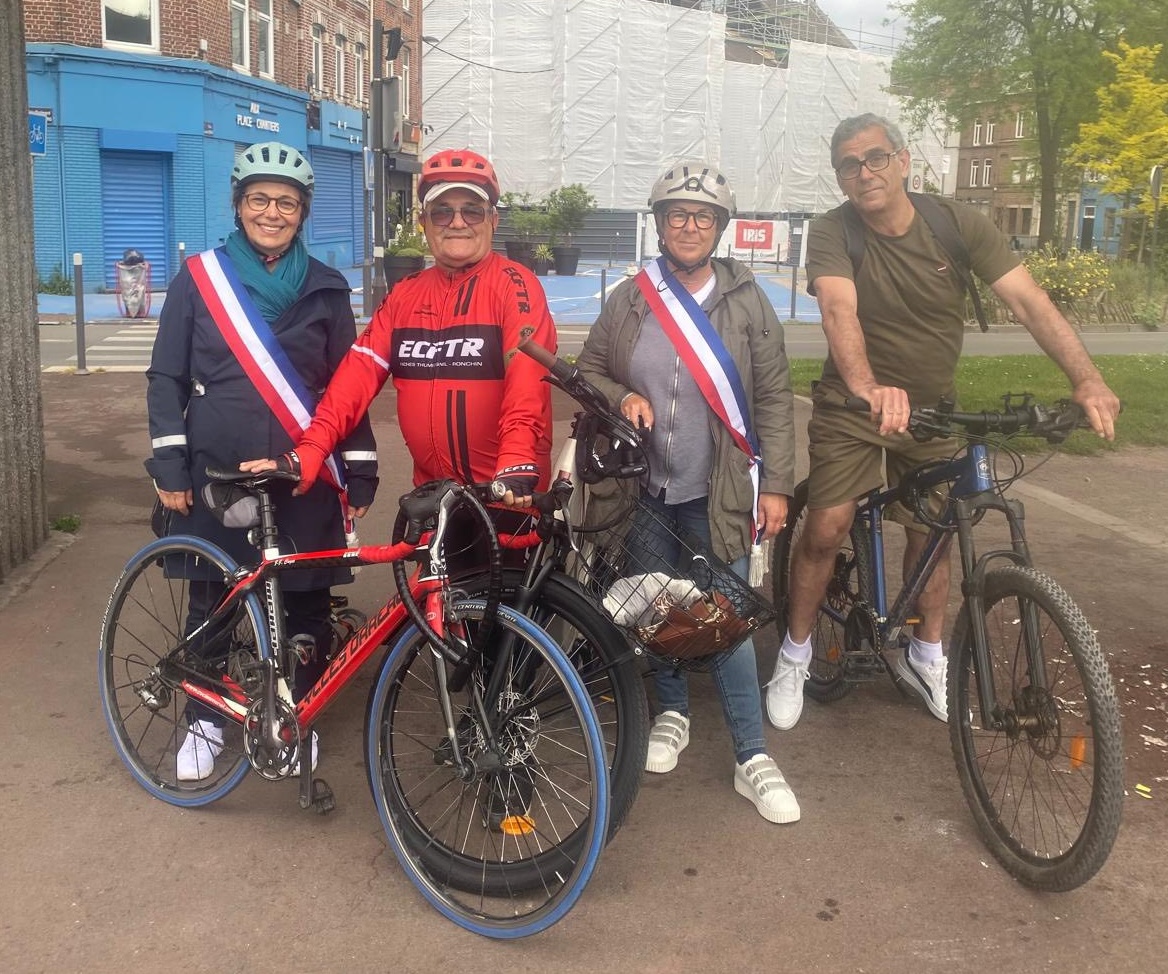
As I got closer to Fâches-Thumesnil, I was joined by Jean-Jacques Cogez, president of the local cycling club ECFTR, along with several of the town’s deputy mayors, who had all come out to ride the last kilometres with me. That gesture meant a great deal. Arriving into town not alone, but alongside people from the community I’d cycled all that way to visit — it felt exactly right.

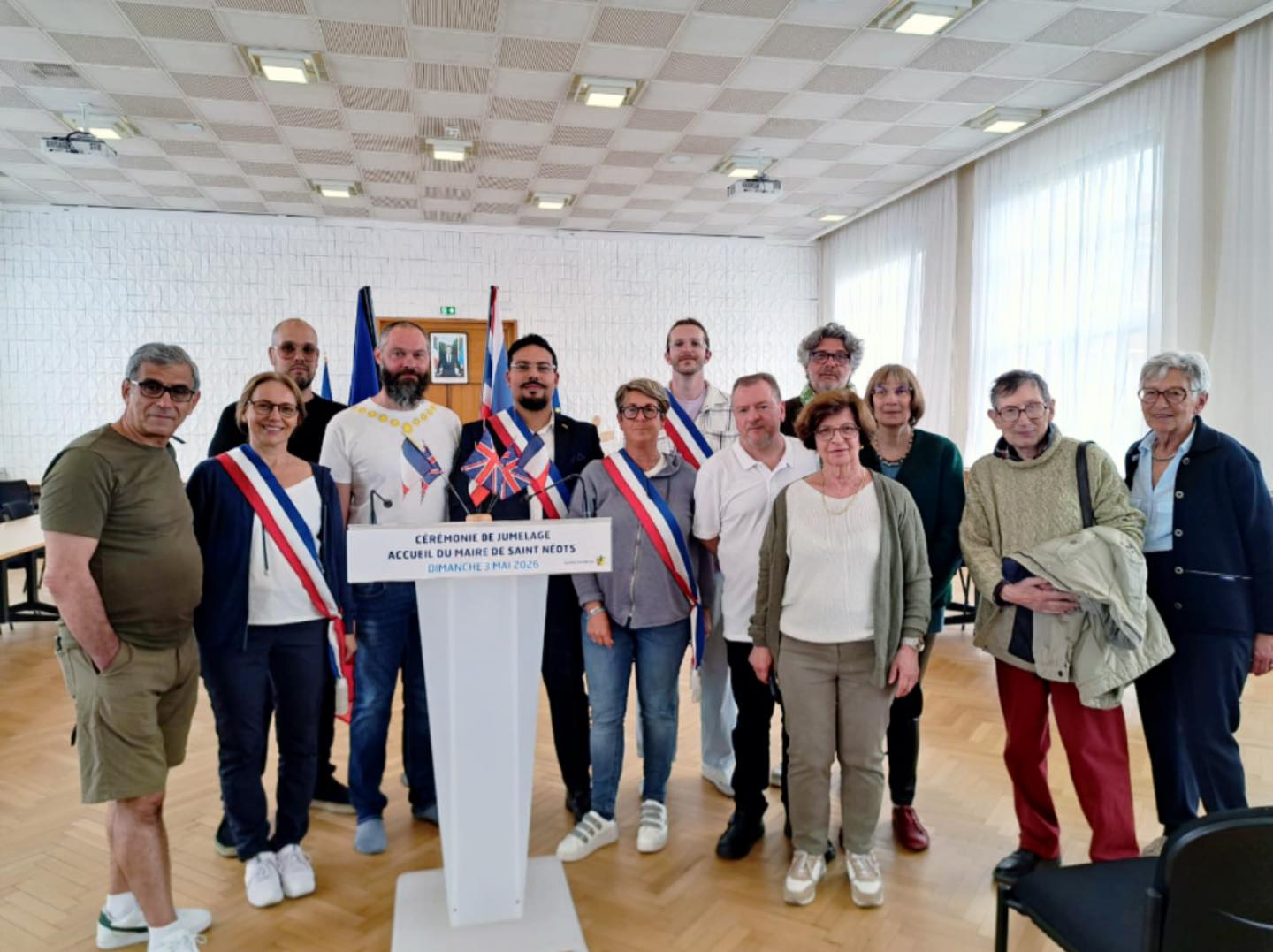
At the town hall, I was met by further elected members of the council, members of the twinning committee, and a real warmth I hadn’t fully expected. There were speeches, gifts — including a beautiful medallion bearing the town’s crest and a local sweet delicacy — drinks, food, and a welcome that was genuinely overwhelming. Jean-Jacques presented me with a symbolic keyring in the shape of a chainring, which I’ll treasure.
Mayor Brice Lauret, newly elected just weeks earlier, was unable to be there in person due to a prior commitment, but his first deputy Mohamed El Allali spoke on his behalf with real generosity. He spoke about the renewal of the twinning, about shared commitment, and about the hope that this visit might open new chapters in sport, education and culture between our two towns. I was deeply touched.
After freshening up at the Hotel Agena — provided as a courtesy by the twinning committee and its chair, Bernard Dewasch — I was collected by deputy Frédérique Coisy and colleagues on a minibus and taken to dinner in Lille. We ate Le Welsh, a proper Flemish brasserie staple: melted cheddar, beer, ham and bread. The food was wonderful, the company even better, and we spent the evening swapping stories about our towns, our councils, and our very different experiences of local democracy.

By Monday morning, the body had issued its verdict: 360km was enough. My legs were protesting loudly and, more decisively, the bearings in my rear hub had developed an interesting noise that suggested they shared the same opinion. The bike and I agreed — we would take the train to Calais.
I’m glad I did. The French rail system is half the price of the equivalent journey in the UK, and the trains have dedicated cycle racks that actually work. You can tell they love cyclists over there. It was a civilised end to what had been anything but a civilised few days in the saddle.
On the way back to the hotel the previous night, my hosts had taken a small detour to show me something: a street in Fâches-Thumesnil named Rue de Saint-Neots, laid out in honour of the twinning. Thirty-five years of friendship, marked in stone. It was a quiet moment, but it stayed with me.
From Calais, Le Shuttle back through the tunnel, and then the train home to St Neots.
The cycling was one thing. But what I’ll carry longest from this trip is what I saw and heard about how Fâches-Thumesnil works as a place.
The council there runs everything: the infant schools, the junior schools, the crèches, the roads, the library, the arts centre, the sports facilities, social welfare. Each deputy mayor has a specific portfolio — education, sport, finance, ecological transition — and residents know exactly whose door to knock on. It’s a commune of around 19,000 people, a dense urban suburb of Lille, and it functions with a clarity of accountability that I found genuinely striking. One tier, one set of people to vote for or against based on whether your life is actually getting better.
St Neots is bigger, more spread out, faster growing. We operate in a different system. But spending time in Fâches made me think about what we value in local democracy and whether we always make it easy enough for residents to know who is responsible for what.
The twinning began in 1990. Over 35 years, it has had its ebbs and flows. But what I found in Fâches-Thumesnil was a municipality genuinely invested in the relationship — a new mayor, a new council, and a twinning committee full of people who care. In such a short time, I made real friends. And we’ve committed, together, to giving this partnership new energy.
The fundraising for my chosen charities continues, and your support — every donation, every kind word shared — made a real difference to how this felt out there on the road.
Thank you, St Neots. And thank you, Fâches-Thumesnil.
With the promise of perfect spring weather and a window of free time, the St Neots gravel riders set out on a slightly more ambitious adventure than normal—a 91 km route sourced from the old club website.
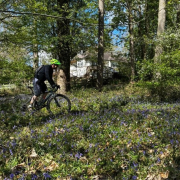
There were glorious bluebell-lined trails around Sandy RSPB and the Biggleswade Green Wheel to Jordan’s Mill—riding through these stretches felt positively angelic. However, there was a little too much tarmac before the off-road climb that marked the turn back home. The effort was rewarded by smooth gravel and tranquil back lanes at the halfway point and a stop at a café for some superb bacon sandwiches at the brilliantly named Disco-licious (no mirror ball or 70s tunes unfortunately).
After refuelling at the café, the ride took a devilish turn. The route after Chicksands was blocked—a gate and a no entry sign—forcing a detour onto the busy A500. We persevered, navigating Bedford and the A603, before regaining our mojo along the path from Bedford Priory Park to Great Barford, remembering when Simon nearly cycled into the river and ended in the nettles last summer.
Embracing the explorer spirit, we turned off at Roxton, wandering through bridleways and welcoming a bit more chaos. The 100 km milestone was hit, and the riders rolled home a lot later than planned with a few more miles in our legs than expected. More rides to come during the rest of the year, all welcome.
MIPIM, described as the Global Urban Festival, is the world’s leading property trade show held annually in Cannes in March. A major event for the property industry it attracts attendees and exhibitors from all sectors of the property industry – architects, engineers, contractors, local authorities, developers, investors…
Held against a backdrop of spring sunshine, private parties on yachts moored off Le Croisette, bars on the quai side, bursting early-afternoon, with Champagne quaffing deal-makers (nobody cares it’s 5 o’clock somewhere), late lunches that extend to dinner, big gold watches and air kisses. It’s social media curated glamour, experienced in real time, at an event often criticised for excess.
Imagine the sight then of sixty, somewhat bedraggled, cyclists, rolling into Cannes, having ridden 100 miles earlier that day through the foothills of the Haute-Provence Alps, and spent the previous 5 cycling from London. Many of these sixty swap their Lycra for suits, to join colleagues who’ve taken a few hours to fly to the Cote d’Azur.
This year, I was one of the sixty who had just completed the 2026 Knight Frank Cycle to MIPIM. Cycling from London to Cannes via Portsmouth, Caen, Blois, Grenoble and Greoux-les-Bains. The entire distance of 1372km with 16000m of climb, completed in 6 days.
Cycle to MIPIM began in 2006 when Peter Murray (a face in the London property scene), with a dozen or so other cyclists, decided to pedal to Cannes as a more sustainable way of getting to MIPIM, and raising funds for charity in the process. From that inauspicious start, the ride has morphed into Club Peloton, a grant-making organisation that arranges property-industry connected fundraising cycle events, which has raised over £5m for charities in twenty years.
I rode the event in 2007 and again in 2012, and have had a longstanding relationship with the event and the organisation since its inception. Only 5 weeks ago I mentioned to Nick, Club Peloton’s Chief Executive, that I was a bit sad not to be able to join the 20th anniversary ride. He replied there’s one space left. I didn’t really need to think about it overnight. I did but I was in.
5 March 2026, 9:30 am, Battersea Power Station. The start of a 6-day challenge to cycle to the Mediterranean.
Participants range from club cyclists to commuters to those who started cycling just to take part. The ride itself takes the form of a relay. 3 teams, each with its own industry sponsor, must complete a minimum of 2 legs, about 120km, per day. Some choose to ride more, and a significant number ride the entire distance. Many ride well beyond their expectations (and perceived capabilities), buoyed by the encouragement and camaraderie of their team-mates; for the challenge, to test themselves and to fulfil their sponsorship. The distance and the ascent are not the only tests. Early starts and late finishes mean long days in the saddle. Conditions ranged from freezing rain to t-shirt weather, often in the same day. The climbs are stacked towards the 2nd half of the week, with some climbs taking riders over 1000m.
Cycle to MIPIM is an incredible event.
With the benefit of a lead car and a motorcycle escort, there is no stopping at junctions, red lights or roundabouts. Mechanical and medical assistance follow the group on the road. Riders are well looked after at feed stops, with sports therapists to help with niggles. Hotels are excellent. The only thing you need to do as a rider is make sure your bag is on the coach and you’re ready to ride when the next leg starts. It doesn’t take a small leap of imagination to think this must be just a little like riding the Tour De France!
During those low moments – cold, wet, early mornings, free-wheeling into the unrelenting spray of the rider in front, are not my thing – I reminded myself how fortunate I was to be able to spend 6 days riding my bike with absolutely nothing else to do. Not a dad, partner, business owner, contractor, or colleague – 6 days with no other responsibility than to ride a bike, look out for the rider behind and generally keep spirits up, especially when others were clearly struggling.
Bon courage, a construction worker on the dam at the bottom of the spectacular Gorge du Verdun – think of helicopter footage from the Tour – as he made sure our passage through the roadworks was safe and unhindered. Bon courage, a leathery-faced old man – think moody Rouleur photography – shouted and waved as we sped past through a small village of cobbled streets tightly flanked by sand-walled houses. Bon courage, late-night al fresco revellers – think friendly inebriated rugby fans or those who have spent the entire day drinking at the side of the road for the peloton to pass in a second – who cheered us through the winding streets of Blois as the motorcycle outriders showed incredible skill and bravery, speeding to the next junction so we could continue unhindered.
Bon courage roughly translates to good luck but it has a different meaning. Bonne chance translates directly to good luck – good fortune in a situation beyond your control. In German, the expression is Viel Erfolg – wishing you success. It’s less emotional than the equivalent French but both languages have an expression that leaves out the element of chance implied by the English ‘good luck.’
It seems to me a shame that in English we lack an expression of encouragement for those who are taking on a challenge for which they have trained and prepared, which tests their capabilities, pushing them to realise new ones. Those who have cycled from London to Cannes over the last 20 years have not relied on luck. Whether they rode their allotted relay legs or more or the entire distance, they completed the challenge through preparation, dedication, training and at times, grit and determination.
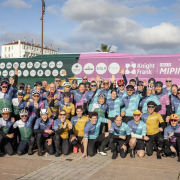
Our arrival in Cannes was certainly a spectacle but I’m not sure anyone sipping Champagne in a bar on Le Croisette would appreciate just quite what those 60 riders had achieved – individually and as a group. Nor the significance of their contribution to Club Peloton. Over £130,000 this year and counting, to fund the ongoing work of Coram, Cyclists Fighting Cancer and The Tom ap Rhys Pryce Memorial Fund, to transform the lives of young people. But in front of the bus parked on the promenade as we all huddled in a little bit more to be in shot for the publicity photo, we all knew the courage of the previous 6 days, and how raising sponsorship and awareness changes lives. Not just of those who benefit from the work of Club Peloton but for all of us who have been involved and cycled to MIPIM at any point over the last 20 years.
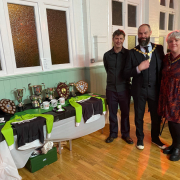
This year, we re-launched the tradition of holding the Annual Awards Ceremony separately from the AGM by hosting a more formal dinner at the Church hall, where partners of members would also be welcome.
We organised way too much alcohol (clearly me being half Scottish and half German, I totally overestimated how much people would drink when the chair asked) – and food was provided by the amazing Jane Parker, and what a delight that food turned out to be. With special thanks to Jane Parker Cooking for the food, Welch Bakes for the bread, Shume for the beer Mayor of St Neots, Richard Slade, and guest speaker Simon Warren.
I feel that we also really need to mention here just how much effort the chair put into making this evening happen – think he could have a career in event organising – and of course a big thank you to everyone who helped, and who made this evening so special (Veri’s very special table cloths and napkins – from her wedding no less – added a bit of extra as well.
Proceedings were opened with a very moving speech from the Mayor of St Neots, Richard Slade. Thank you so much, Richard.
After the food, Simon Murphy certainly got his steps in walking to and from the stage to collect his many awards – this coming season, we really need some more people out there giving him a run for his money! And the same goes for Dawn… I’m coming for you. But there were more awards to be won this year, with a few reintroductions of former awards, and some brand new ones as well.
We had a great speaker in Simon Warren, thank you to Simon, and to Justin for organising and preparing the interview-style questions – we will do this part of the evening proper justice with a separate report (once the chair is back from his crazy trip).
Most weeks, having ridden the furthest distance – Justin Lomas (with a crazy total of 13,248 miles, although that is not how that prize is won, it’s still worth mentioning)
The Meritorious Award this year goes to Stuart Williams for his tireless efforts throughout the off-season, running the Monday evening Strength and Conditioning classes. He’s put us through our paces again and again, and somehow manages to make it fun as well as very effective! Thank you, Stuart. Your efforts are appreciated. As Justin said yesterday, I complained about being in pain on Tuesday, Wednesday, Thursday… and then I am back again for more next Monday.
The Club Member of the Year Award goes to Simon Winter, who really represents what it is to be a great club member. He started the year supporting JC after his fall, he throws himself into everything the club has to offer with great enthusiasm… You put something new on, Simon Winter will be there to support it. Melton Mowbray ride, he’s there. Off road in Thetford – he’s there. He’s the first to put his name down for the Dales weekend. When Stuart wasn’t available to do the S&C, he enthusiastically took over, and when Stuart is there, he will still be cheerleading us.
And finally, the one you voted for, The Rider’s Rider Award Thank you to everyone who voted – and the winner is Stephen Ellerbeck
“Stpehen is always there with a smile on his face, happy to chat when riding, making sure all doing ok as well when in a group”
Many of you will know that in June last year I took part in the Manchester 2 London ride supported by Rapha to raise funds for Ambitious About Autism. [This is a cause very close to Simon Mottram, Rapha’s founder, who has a severely autistic son.] The ride itself was 220 miles from central Manchester to Rapha’s HQ in Archway, London, passing through the south Peak District, with 4 feeds stops including The Hub and Spoke Cafe, Dunstable (where I was very well looked after) and The Sharpenhoe Clappers before the final run-in through North London.
I was asked by someone why I was taking in part . I would have liked to say that the cause was close to my heart but the truth is, it isn’t. I can possibly say that about all charity events – I’m happy to help raise funds whatever the cause because they are noble, provide help and support to those who need it, and cast cycling in a positive light. So why this event? Well, I spend a lot of time riding a bike for no other purpose than to benefit of my own mental and physical health. Reason enough, but it feels right that sometimes the somewhat selfishness of hours pedalling solo has a greater purpose and wider benefit. And 220 miles in a day was at the limit of what I thought I might be capable of and provide a focus to my day-to-day training.
Training which needed some long rides.
Roll back two months and I’m in a car park in Huntingdon, having joined Richard Slade, Tom Stead, Simon Winter and Ed Hemms to the ride up from the Market Square, surrounded by a crowd of other cyclists of all flavours on a variety of different bicycles. This was the start (the first control) of the Double Dutch Audax to Kings Lynn and back. My first Audax.
I will be the first to admit that I am not immediately enthusiastic about Audax events.
You mustn’t ride too fast, you can’t ride too slow.
I get it – the checkpoints can only be open for a certain amount of time, but it goes against a deeply ingrained sense of competition. Sure, try harder, dig in, grit yer teeth when riding into a headwind (to arrive at a checkpoint before it closes) but putting the brakes on, or stopping to rest, when you’re enjoying a taliwind or one of those all too rare days when with glass cranks when pedalling is effortless, to avoid arriving at a checkpoint early, seems a shame. Even more so when eBrevet means that no card is stamped so checkpoints can now be open 24 hours.
But I am respectful of the traditions of cycling and am not a fan of the cycling-by-numbers that has pervaded the sport. I prefer riding on feel not a maintaining the number displayed on my head unit. Using the data (heart rate and speed) as a guide not a master. I like that you can still carry a Brevet card and a pencil to have it marked when you reach a checkpoint. I’d revert to paper maps but I am a fan of being able to look down and see the dotted line of the route displayed in limited colour on the screen attached to my handlebars.
The thing is, my reticence for an Audax isn’t logical.
I’d love to ride Paris-Brest-Paris. It’s an Audax!
But to me it’s so much more than that. It has a history as a race and is now an amazing spectacle of cycling. I imagine it’s a truly enjoyable and unforgettable experience. But to ride it you have to qualify, completing a series of specified Audax distances in the a predefined period prior to the event.
When we were at the Dales Weekend last year, the Bike Centre was the most northerly checkpoint for an Audax event from somewhere a long way south and back, over lots of hills and by far from the most direct route. Cyclists were arriving late; cold, wet and tired, setting up make shift camps in bivvy bags at the side of the car park, as we came back from the pub, and I thought ‘that looks like fun!’
I’m no longer a spritely road or track racer but coming back to cycling in my early 50s, after a mid-life break to deal with mid-life stuff, I’ve regained some of my youthful fitness. But I’ve been re-tuned from supercharged V8 petrol to a turbocharged V12 diesel. Maybe just a V6 diesel with economy features! I can ride reasonably quickly for a long time and I have the experience of knowing when and how to save energy and when to expend it.
In the past, I was always training for the next race, training to beat everyone else to the line. Maybe it’s a sign of aging, an acceptance that my racing days are behind me, or maybe it’s the result of shift in cycling generally. Competition isn’t just about the race – you can compare against others, but you can also compete against the terrain, the weather, the gradients, the distance, yourself and what you think you are capable of. And cycling is much more than the Tour de France, the Monuments, and the televised races of the pro-ranks.
On a bicycle we can go further than travelling on foot, we can reach places we can’t in a car, and we are more connected with the environment.
The bike is simply the best tool for spending time outside.*
And, as I discovered, an Audax is great way to spend time on a bike. We set off as a group of five into a headwind. We caught/or got caught by a huge group of riders from St Ives CC and rode as a peloton into the headwind. Got dropped when stopping for a natural break. Chased back on, sat in, recovered. The group split at a Greggs somewhere on the flatlands (Chatteris, March, Wisbech?) We stopped for a bacon sandwich in Kings Lynn (I won’t be ordering one of those again mid-ride!) Ed phaffed with a rubbing disk rotor, and there was possibly a puncture. We sped past technicolour tulip fields. Hammered along poor roads running alongside a dyke enjoying a terrific tailwind. And stopped in Ely where Ed demonstrated the rejuvenating power of Coca-Cola. The last section of the ride I remember was the super smooth path alongside the guided busway back to St Ives, then back to the final checkpoint at Wetherspoons in Huntingdon.
My first Audax, 200km. Done.
Except that it was only then I discovered that eBrevet is not automatic. You do have to stop at the checkpoints, and digitally stamp your Brevet card. We did this at the first one but rode through all the others.
We hadn’t officially completed the ride and we couldn’t collect our badge.
Ah well. You’ll probably find me in the car park in Huntingdon on 4th April 2026 for the Double Dutch 2026. This time with a pencil and perhaps I’ll take the time to stop at the checkpoints.
*Dan Pettit/Albion
I’ve been a cyclist most of my life, but I wouldn’t have called myself a cycling enthusiast. For years, the bike was just something I rode now and then. I didn’t buy my first proper road bike until 2019, and even then it wasn’t anything special — an old Trek 2.3 Alpha, bought sight unseen from a mate for £185. I figured if it was big enough for him, it would be big enough for me.
That bike still hangs from the ceiling of my shed.
Like many people, my real cycling journey began during lockdown. I started with five miles, then ten, then fifteen. Nothing heroic. Just getting out of the house. Eventually I could ride 25 miles comfortably, so I set myself a small challenge: 25 miles a day, every day, for 25 days. No rush. No targets beyond turning the pedals.
The first week felt tiring. After ten days I still felt tired, but I could manage it. By three weeks, something odd happened — it just felt normal. That was my first real lesson in endurance: you don’t suddenly become fit, you just stop noticing the effort.
From there, the miles crept up. Fifty became manageable. Sixty felt like an achievement. I rode up to Leicester to see my mum — which at the time felt like a full-blown expedition, complete with cheese sandwiches, fruit and emergency chocolate. Then one day I rode from Cambridge to Bristol to visit the friend who’d sold me the bike. About 160 miles. For years, that remained my longest ride.
Eventually, curiosity pushed me further afield. I decided I’d ride to Geneva to visit a friend. I didn’t really know what I was doing. I packed camping kit, strapped everything to the bike, and headed for Newhaven to catch the ferry to Dieppe. Two miles from central London, I broke a spoke. A local bike shop fixed it and asked where my cycling kit was. I said I didn’t need any. He smiled and said, “You’ll be sore.”
He was right — about many things.
That first attempt at riding to Geneva didn’t go to plan. Covid travel rules intervened, and I ended up turning around before France. But it was still a learning experience, and cycling seems to be made almost entirely of those. One of the things I learned was simple: buy decent wheels. I invested in a sturdy set designed for heavier riders, and the following year I tried again.
This time, I made it.
The journey unfolded in fragments rather than stages: the South Downs out of London; a quiet ferry crossing; rolling off into France and following parts of the Avenue Verte; freestyling routes when things wandered too much; sleeping in bivvy bags when campsites turned out to be little more than car parks in the woods.
Paris arrived almost by surprise. The outskirts were eerily quiet, then suddenly everything was busy — it was Bastille Day. Bridges were closed, parades everywhere, and I found myself watching the French Foreign Legion march through the city before heading on my way.
Further south, the rhythm settled in. Long Roman roads. Canal paths that began smooth and inviting, then turned into washboard mud and overgrown grass. Small towns that looked deserted until you climbed one last hill and found life, food and somewhere to sit.
The mountains came gradually, then all at once. Long, grinding climbs on a heavily loaded bike. Careful descents. And then, one day, a sign at the top of a pass: Switzerland.
That ride took eight days. I learned more than I can list: about navigation, pacing, kit, and my own limits. But more than anything, I learned why riding a long way suits me.
The last few years had been heavy ones. Losses in the family. Illness among close friends and colleagues. Cycling became a place where I could process things without having to talk about them.
That’s probably why Audax appealed when I eventually discovered it. Cycling a long way, slowly — but not that slowly.
If there’s one thing I’d pass on to anyone in the club who’s curious about riding further, it’s this: you don’t need to be fast, or fearless, or especially brave. You just need to be patient, a bit stubborn, and willing to see what happens if you keep going.
Sometimes, a long way slowly turns out to be exactly the right pace.