Longues-sur-Mer, Normandy
Trying to eke the most out of the hottest summer on record, 8 intrepid travellers (7 SNCC members and 1 guest) headed over the pond to Longues-sur-Mer in Normandy. The purpose of the trip was twofold: to get some miles in on the quiet, flat(ish) Normandy roads while also visiting the best of the D-Day memorial sites. Longues-sur-Mer is ideally situated between Omaha and Gold Beaches, with the other D-Day beaches (Utah, Juno and Sword) all within easy reach.
The trip was conceived in September 2023 when Martin, Mark and Mike did the Pyrenees coast-to-coast traverseé, accompanied by Martin’s friend, John Hammond, who transported the trio to and from the departure/arrival points in his Ford Transit. As well as being a qualified bike mechanic (always handy on trips such as these), John is an enthusiastic amateur historian and regaled the trio on the long drive down to Collioure, the start point for the Pyrenees crossing, with stories of the Allies’ daring exploits during WWII. A return trip was suggested to combine some pedalling with the D-Day highlights, with John as the tour guide, and two years later here we are.
Getting there
As for the Pyrenees trip, Martin, Mark and Mike travelled over with John in his transit. With John living near Reading, he opted to take the 6-hour Portsmouth-Caen ferry followed by a short drive to Longues-sur-Mer. The other foursome, comprising Tom Muldoon, Simon Winter, Alistair Henderson and David Thomas (not he of Everesting fame, but his Buckden namesake), opted to take the shorter Channel Tunnel crossing to Calais, followed by a longer 4-5 hour drive to Longues-sur-Mer. Swings and roundabouts, with the overall travel times being about the same.
The villa
After a lifetime of executive travel, Martin refuses to stay anywhere “budget” and sourced “L’echo des Vagues”, a magnificent 10-bed villa within a mile of the coast, complete with its own pétanque pitch and BBQ area for some light evening entertainment.
We found the villa, located on the suitably named “Route de Chaos”, without too much trouble and settled in. Since the weather was forecast to deteriorate over the week, we thought we would make the most of the warm evening with a first-night BBQ, fuelled with a plentiful supply of local beer and wine.
Unaccustomed as he was to the new accommodation, Martin made a rookie error and walked straight into a (closed) patio door, almost breaking his nose and the door in the process. At least he’ll blend in with any hardened war veterans he might encounter over the coming days.
The cycling
The 5 D-day landing sites are spread across the Normandy coastline between Cherbourg and Caen:

The more organised ones in the group did some groundwork before we left, with John proposing a list of sites worth visiting, Mark plotting some Garmin routes and Martin linking together the points of interest into point-to-point Google “itineraries”. The aim was to cover the 5 landing sites with 4 routes:
With the best weather forecast for the first riding day, we opted to head out on the longest route, a 95-mile round trip to Utah beach. Immediate impressions were of flat roads (no more than 3% gradient), great road surfaces (not a pothole to be seen) and virtually no traffic (the only real hazards being the occasional tractor or loose bit of gravel) – cycling heaven.
Having reached our destination at Utah beach without incident, a few of us visited the museum which provided a great insight into the trials and tribulations of the Normandy campaign, while others opted for an early lunch. Martin made it clear that this wasn’t a guided tour and to do whatever took your fancy. Whatever personal choices were made, the vast scale of the D-day landings and the subsequent Normandy campaign, the acts of heroism and tragic human loss made a huge impression on us all.
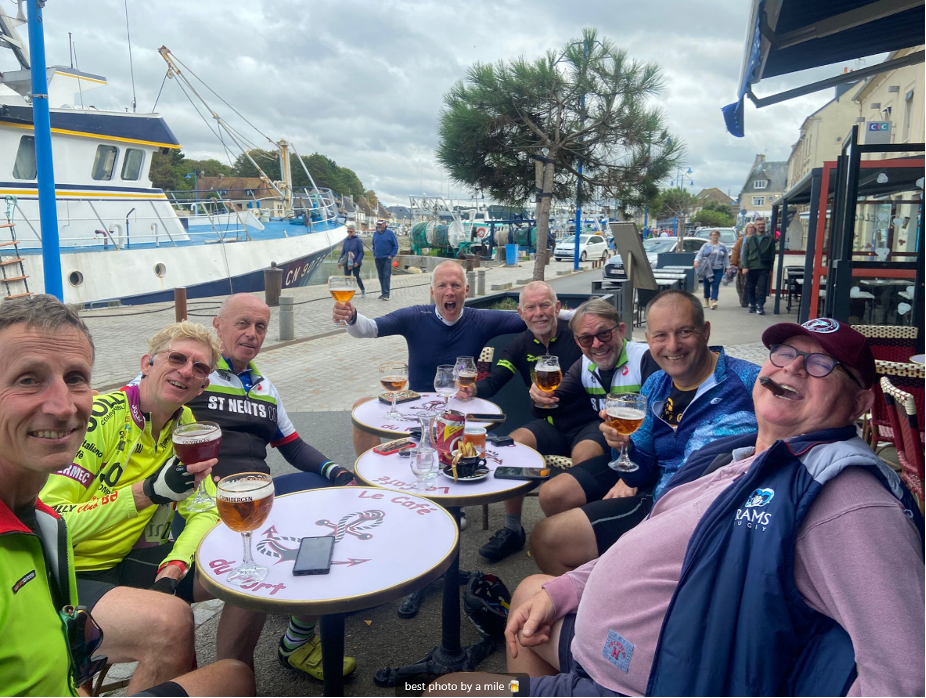
The pattern was repeated over the next few days with rides out to Omaha beach (Day 2), Sword beach and Pegasus bridge (Day 3), Gold & Juno beaches incl. a deviation to Bayeux (Day 4), exploration of the British Memorial at Ver sur Mer (Day 5) and a venture further inland to Saint Lo (Day 6), culminating in a rather messy beery finale at Port du Bessin – you’ve probably seen the videos so I’ll say no more! We all racked up a fair few miles with a strong showing in the club’s stats for the week.


The memorials
It’s fair to say that there are a lot of war memorials in Normandy, ranging from statues or plaques, marking particular events or acts of heroism, to full-blown museums giving much wider insight into the Normandy campaign and its relevance to the outcome of WWII. Although all were well worth visiting, I found the following to be the most memorable (see the Hollywood epic, “The Longest Day”, for more details)
- The museum at Pegasus Bridge: telling the amazing story of the strategic assault on Pegasus Bridge by British Airborne troops in Horsa gliders, which kicked off the D-day invasion
- The British Memorial: a stunning memorial to the British soldiers who died during the Normandy campaign. At the time of our visit, the site also featured the “Standing with Giants” travelling memorial – 1,475 silhouettes near the beach representing the soldiers who died on the first day of the D-Day invasion and a further 50 silhouettes of the French Resistance in the woods – a truly memorable and thought-provoking spectacle
- The American cemetery: the huge loss of life that is honoured at a war cemetery always strikes a chord with me and this one was no exception
- St Mere Eglise: a reconstruction of an American paratrooper suspended from the church spire, highlighting one of the many risks that paratroopers might face.
Memorials such as these will affect us all differently depending on one’s particular take on world affairs and family history. In my case, my father was part of the D-day invasion, landing on Day 2 as a Captain in the Royal Engineers. Visiting the Normandy sites therefore reminded me of the horrors he must have witnessed and of the debt we all owe to his generation. After the war, he joined the Commonwealth War Graves commission and was responsible for building cemeteries in Italy, San Marino and Malta, hence why the American Cemetery was so poignant for me.
The D-day landings have even greater resonance for Simon, since his great uncle, Philippe Keiffer, was the leader of No 4 Commando, consisting of 177 Free French green berets who were instrumental in defeating the German stronghold at the Casino in Ouistreham. Virtually wherever we went we found mention of Keiffer’s exploits – he featured in the introductory film at the Pegasus bridge museum, introduced by HRH (now King) Charles; there was a photo of him being decorated by Field Marshall Montgomery at the American Cemetery; and we visited the street named after him, the “La Flamme” memorial and the No 4 Commando museum in Ouistreham. Although Simon is at pains to point out that Keiffer wasn’t a blood relative, that is still an amazing connection to the events of D-day which helped to bring the trip to life for me. We were also fortunate to meet Keiffer’s daughter Dominique, Simon’s cousin once removed, and her husband Didier who have a house in the area and are still actively involved in the D-day remembrance celebrations each June.
Tour mishaps
In addition to Martin’s close encounter with the patio doors, we also had a few other mishaps on tour (which I am prepared to divulge)
- Dave’s phone: after returning from a visit to the American cemetery, Dave realised that he’d lost his phone. He contacted his wife in the UK to help, with a view to locating the phone using “Find my Phone”, to be told that a French woman had already found it at the cemetery and contacted her. In true WWII fashion, the woman hid the phone under a pile of leaves on a bench for Dave to collect later – disaster successfully averted.
- My Oakley’s: similar to Dave’s loss, I got back from the day’s ride and couldn’t find my shades – an expensive pair of Oakleys which were a birthday present last year and I really didn’t want to lose. When Mark advised that I hadn’t been wearing them on the return leg of the ride, I concluded that I must have left them in the museum at Utah beach and could even visualise where they must be. I was just about to contact the museum when said shades turned up inside my helmet – now, who put them there???
- Tumbles: Simon had at least 2 minor tumbles, but that’s just a standard day at the office for him, so not really worthy of reporting here
- Tour finale: to mark the end of the tour, we agreed to ride out to Saint Lo, then head to Port en Bassin, a 70-mile round trip, for lunch and a couple of celebratory beers. Simon and I had agreed to meet up with Dominique and Didier and then catch up with the group later. When Simon and I got to Port en Bassin, it was plainly evident that the rest of the group had forgotten the first part of the plan (lunch) and just doubled up on the second part (beer). It’s just as well that we only had a few miles to stagger back to the villa and, in Tom’s inimitable words, “We will get home”, but I think I am correct in stating that club riding etiquette was not strictly observed on the way home. Fortunately, all survived to fight, or ride, another day.
Summary
Everyone agreed that it had been a fantastic trip: the weather was great with only a few short showers, the roads were magnificent and the company was everything you could hope for from a great bunch of lads. We were also extremely well fed and watered. In addition to the customary cheese, wine and pate you would expect on a French trip, we also enjoyed numerous BBQs, c/o Martin & Dave, moules à la Simon, a great take on a classic French dish, and ½ tonne of chilli, c/o me. Whoever said, “the great thing about cycling is that you can eat whatever you like”, clearly didn’t take account of the huge portions we devoured during the week, so my winter training programme may need to start a little earlier than was originally planned.
Apart from the memories of a great week’s cycling, the other thing that will stay with me for some time is a reminder of the huge debt that we owe to those who fought and died 80 years ago to provide the type of lifestyle we all enjoy today.
Mike Biggs, September 2025
